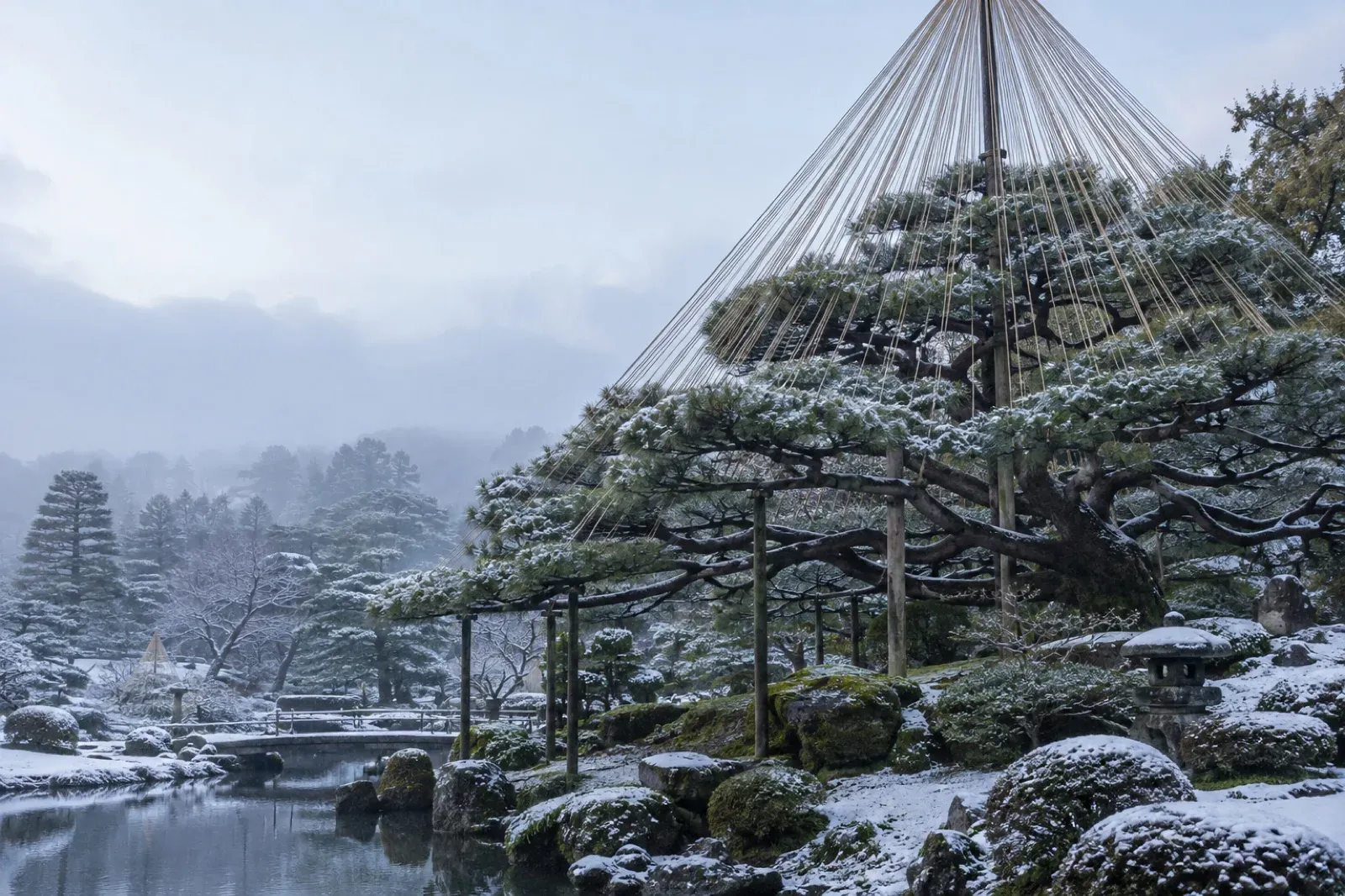
Kanazawa / Guide
Kenrokuen, Kanazawa: Follow the Water Uphill, From the Waterfall to Where It Comes In
Kenrokuen兼六園
The garden’s water was dug for the castle
Kenrokuen is one of Japan’s three great gardens, and almost everything that moves in it is water that was brought here for another reason.
In 1632 Maeda Toshitsune, the third lord of Kaga, had a channel dug to carry water from the upper Sai River to Kanazawa Castle. The prefecture gives fire as the first reason. Only later did the same water become the garden’s stream, and the prefecture says it still does that work today: the brooks, the waterfall and the ponds all run on the Tatsumi canal.
I like that the loveliest water in Kanazawa began as a precaution against the city burning. It changes what you are looking at. The stream is not decoration that happens to flow; it is a working channel that someone, a long time ago, decided to let wander.
So walk Kenrokuen against the current instead of ticking off its sights. Start low, at the gourd-shaped pond where the garden began, and climb with the water coming towards you, up to the hill where it comes in. Every famous view you pass is on its way.
Start at the bottom: the gourd pond and the waterfall
Come in through Renchimon, the old front gate, if you can. If you arrive by another gate, walk down to this pond first rather than starting at the big one. Renchimon puts you beside Hisago-ike, the pond with a waist in the middle like a gourd, where the making of the garden is said to have begun.
This is as low as the walk goes, and the water arrives loudly. Across the pond, Midori-taki carries water out of Kasumiga-ike, the big pond above, and drops it into this one. The prefecture says the waterfall pleases the eye and the ear at the same time, and calls it a sight not found in other gardens. Its height is 6.6 metres.
On the bank opposite the falls stands Yugao-tei, a small tea house that has come down, in the prefecture’s words, in its original form. The prefecture’s history dates the waterfall and the tea house to the same year, both made by the eleventh lord after a fire in 1759 had burned part of this corner of the garden. I find that the most persuasive detail in the whole garden: the falls and the tea house facing them belong to the same rebuilding, and I cannot look at one without the other.
Picture the pond early, before the gates have filled: two islands, one large and one small, shaped as the islands of the immortals, a stone pagoda on one of them, and the sound of the falls across the water.
The fountain that was a test
Walk up from the pond to the fountain.
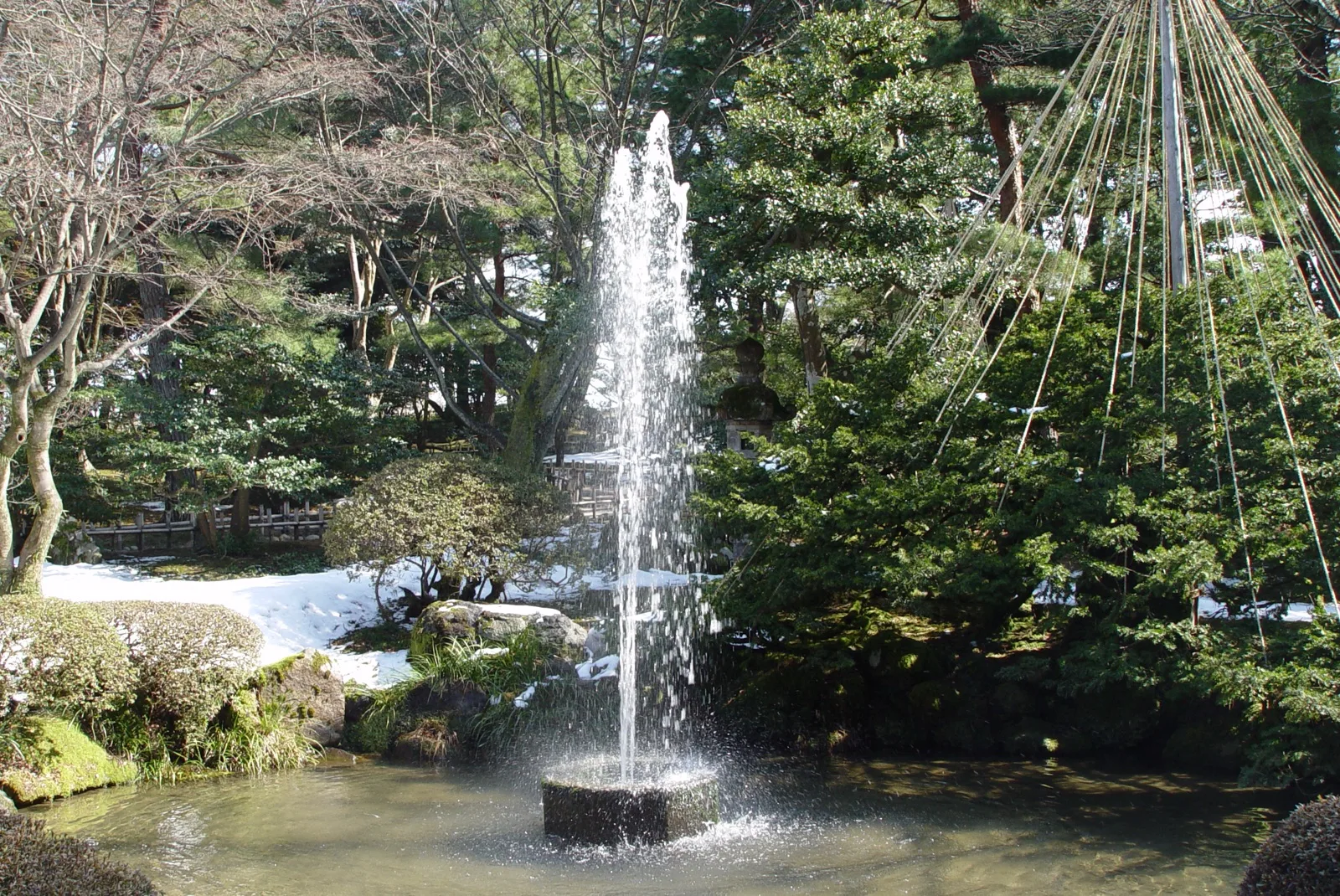
Nothing pumps it. The water comes from Kasumiga-ike, the large pond higher up, and rises on the difference between that pond’s surface and the jet. It rises about 3.5 metres, and its height changes with the level of the pond, so the jet you see depends on how full Kasumiga-ike is that day.
The reason it exists brings you back to the castle. It is said to have been built at the end of the feudal era as a trial for sending water up into the castle’s Ninomaru. The canal did a larger version of the same trick: the prefecture’s survey describes wooden pipes buried under the moat between the garden and the castle, using the principle of an inverted siphon to lift the water up into the Ninomaru.
If the story is right, the fountain said to be the oldest in Japan is a small model of a water-supply problem. That charms me more than any claim about its age: an experiment you can still watch rise from the same pond.
Kasumiga-ike: the big pond is shallow
Climb on to Kasumiga-ike, the middle of the garden and the water’s largest pause.
It is the largest pond in the garden, and yet it is only 1.5 metres at its deepest. Reading that it is the largest pond, I had pictured something deep. What the garden built is closer to a mirror: a wide, shallow sheet of the canal’s water, spread out so that everything around it has something to stand over.
Many of the garden’s named sights are arranged around its edge, but two of them are really about the water. One is Uchihashi-tei, a tea house raised on stone legs so that it seems to float on the pond.
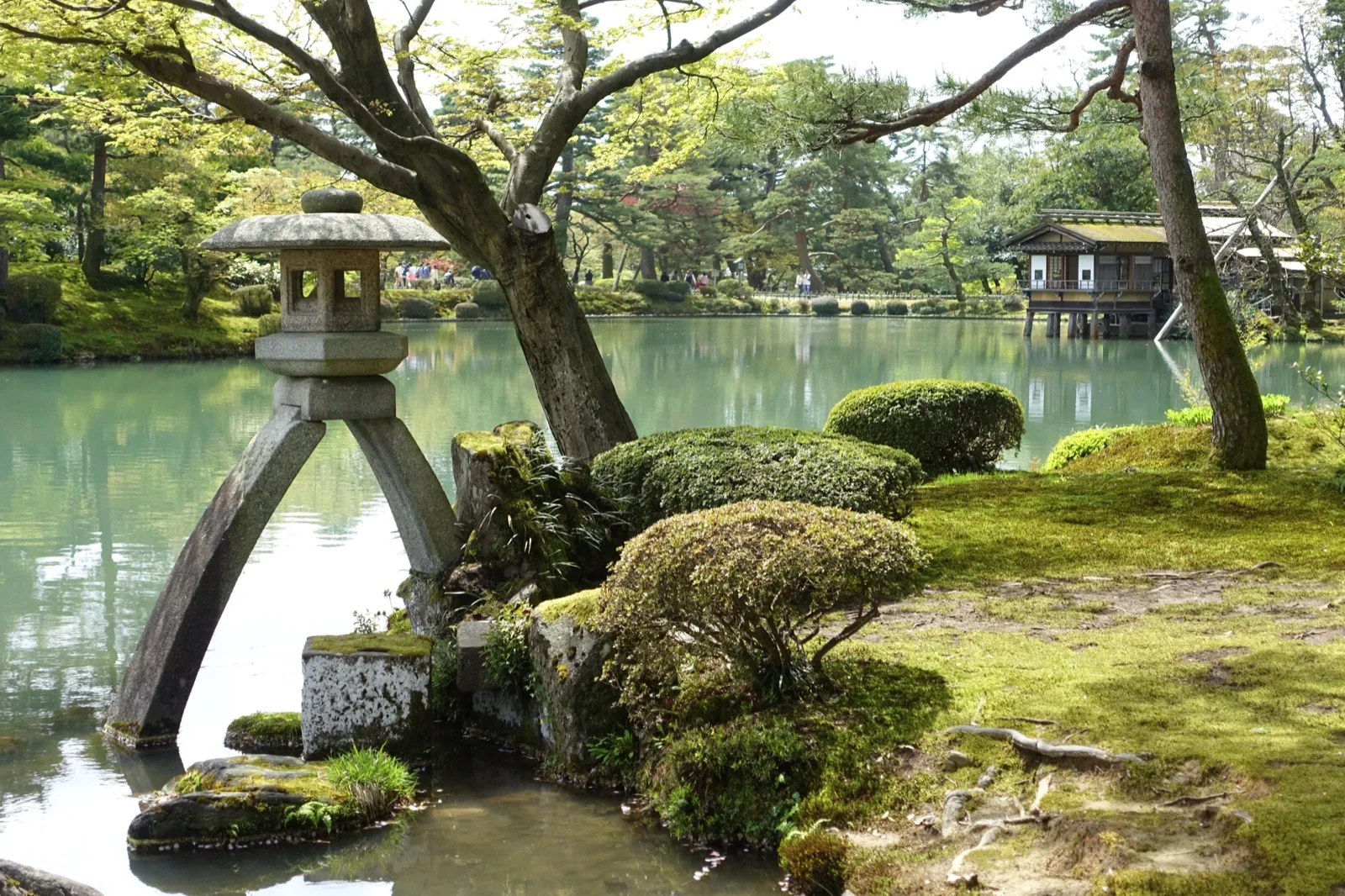
The other is the Kotoji lantern, the view the prefecture calls the one that represents Kenrokuen. Its two legs are said to look like the bridge that holds up the strings of a koto. It grew out of a yukimi lantern, the kind meant to light the surface of water. It is a lamp for the pond, more than a lamp for people. If you want the postcard, stop here; if you want the water, keep going along the shore.
Before you leave the pond, find Oyashirazu, where the slope comes right down to the water and rough rocks line the edge. Those rocks were placed so that they show or disappear as the level of the pond rises and falls. The shoreline works like a gauge: it shows you how full the pond is on the day you come.
Up the stream, against the current
From Kasumiga-ike the water comes to you along a winding stream, and this is the part of the walk I would slow down for.
The stream runs about 570 metres from the foot of Yamazaki-yama to the big pond. The prefecture calls it a gently flowing stream, which is why the sound here is so much smaller than at the falls. It passes under Hanami-bashi, the wooden bridge with the onion-shaped knobs on its rails, named for the view of the flowers along the water: cherries, irises and azaleas in their seasons, then shade in summer, red leaves in autumn and snow in winter.
If you only have time for one stretch of this walk, choose the stream instead of a full circuit of the pond. Walking upstream means the water is always coming towards you. Picture following it past the bridge, the current running the other way under your feet, the sound changing from the waterfall’s roar behind you to something much smaller ahead.
Where the water comes in
The stream begins at the foot of Yamazaki-yama, a built-up hill near the Kodatsuno gate. The water flows out from among the rocks at the bottom of the hill. That is where the garden’s water appears.
The hill is planted with maples and horse chestnuts, which is why it is also called the autumn-leaf hill. If you come in autumn, the water starts its walk through the garden under red and yellow leaves.
The source is much farther away than the rocks suggest. The canal’s intake is on the upper Sai River at Kami-Tatsumi, about ten kilometres away.
The word in the prefecture’s description that stays with me is “later”. The canal was dug for the castle, and only later was its water given to the garden as a stream. That one word changes how I read the route: the water supplied for the castle is what now links the stream, the shallow pond and the waterfall.
When to walk it
If you can be up early, walk the water route in the free early opening, and begin with the waterfall before the paths fill.
The garden opens free in the early morning, at times that change with the season, through two gates only, Renchimon and Zuishinzaka, which suits this walk: Renchimon puts you at the bottom of the water. The one condition is that you leave before the paid hours begin, so the climb to Yamazaki-yama has to fit before then. The times are in the table below.
If you come later, you can walk the same route in paid hours, with more people on the paths. If you come in flower season, allow extra time along the stream for its cherries, irises and azaleas.
Before you go
Hours, prices and getting there
| Free early opening | 1–31 March 5:00–6:45; 1 April – 31 August 4:00–6:45; 1 September – 15 October 5:00–6:45; 16–31 October 5:00–7:45; 1 November – end of February 6:00–7:45. Last entry 15 minutes before it ends. Renchimon and Zuishinzaka gates only; leave 15 minutes before paid hours |
| Paid hours | 7:00–18:00, last entry 17:30 (1 March – 15 October); 8:00–17:00, last entry 16:30 (16 October – end of February) |
| Admission | adults 320 yen, ages 6–17 100 yen; cash, major credit cards, transport IC cards and other e-money |
| Open | every day of the year; evening openings with lights in the cherry and autumn-leaf seasons, dates posted in the prefecture’s notices |
| Free all day | about 7 days at cherry blossom time (late March – early April), 3 days around the Hyakumangoku festival (early June), 14–16 August, 3 November, 31 December – 3 January; exact dates announced about a week ahead |
| Free admission | visitors aged 65 and over with official proof of age; people with a disability certificate and one carer |
| Shigure-tei | tea house, 9:00–16:30 (last entry 16:00), closed 12:00–13:00 and 29 December – 3 January; matcha and sweet 1,000 yen, sencha and sweet 500 yen |
| By bus | from Kanazawa Station, about 12 minutes to Kenrokuen-shita / Kanazawa-jo, then 5 minutes on foot to Katsurazaka gate; or about 10 minutes to Hirosaka / 21st Century Museum, then 5 minutes to Mayumizaka gate |
| By taxi | about 10 minutes from Kanazawa Station |
| Parking | Kenroku car park, 480 cars, open 24 hours |
| In the garden | no smoking, no pets, no bicycles; the gravel paths can be slippery |
The castle park next door also opens free in the early morning, and it is where the canal’s water was going in the first place: Kanazawa Castle.
What I would do
I would go in at Renchimon as early as I could, stand at Hisago-ike and listen to the waterfall for as long as I liked, and then walk uphill with the water coming towards me: the fountain, the shallow pond and its stones, the long stream under Hanami-bashi, and finally the rocks at the foot of Yamazaki-yama where it all comes out.
I would not try to see every named thing in Kenrokuen. I would follow the one thing that connects them, and leave knowing where the garden’s water comes from and why it was dug.
Sources and images
We have not visited Kenrokuen for this guide. It is written from the official Kenrokuen site run by Ishikawa Prefecture and the prefecture’s press release on the Tatsumi canal; where you are asked to picture a scene, that is what it is.
- Ishikawa Prefecture, Kenrokuen official site, garden-point descriptions (Japanese and English) — the Tatsumi canal and its intake, Yamazaki-yama and the 570-metre stream, Hanami-bashi, Kasumiga-ike, Oyashirazu, Uchihashi-tei, the Kotoji lantern, the fountain, Midori-taki, Hisago-ike and Yugao-tei. Checked 18 October 2026.
- Ishikawa Prefecture, Kenrokuen official site, history and about pages — the fire of 1759 and the building of Midori-taki and Yugao-tei in the same year by the eleventh lord, and Kenrokuen as one of Japan’s three great gardens. Checked 18 October 2026.
- Ishikawa Prefecture, Board of Education, cultural properties division, press release on the designation of the Tatsumi canal as a national historic site (November 2009) — the year of construction (1632, with a variant of 1629), the length of about 11 km from the Higashiiwa intake to Kenrokuen, the purposes (fire protection after the Kan’ei fire, the moats and water for the castle gardens), and the buried wooden pipes using an inverted siphon to lift water into the Ninomaru. Checked 18 October 2026.
- Ishikawa Prefecture, Kenrokuen official site, visitor information, Shigure-tei and access pages — hours, the free early opening and its gates and exit rule, admission and payment, free-admission days and exemptions, buses and taxi. Checked 23 September 2026.
- Photographs: the fountain by Jovandavid (public domain, Wikimedia Commons); the Kotoji lantern by Daderot (CC0, Wikimedia Commons).
More in Kanazawa
- Kanazawa Castle — For history, and three buildings that survive from the Edo period
- Omicho Market — For seafood, local produce and an early meal
- Higashi Chaya District — For old wooden streets, and teahouses you can step inside
- Komatsu Udon near Komatsu Station — For Komatsu's udon, before the counter under the tracks closes at three
- Where to Stay — For choosing where to sleep by your mornings: Korinbo for the free hours in Kenrokuen, the station for early trains, Higashi Chaya for the quiet street
Explore other areas
- Hokkaido — Sapporo
- Kanto — Hakone, Tokyo
- Hokuriku — Kanazawa · You are here
- Koshin-Tokai — Fuji Five Lakes
- Kansai — Nara
- Chugoku — Hiroshima
- Kyushu — Fukuoka
- Okinawa — Naha
