Kanazawa / Guide
Higashi Chaya District, Kanazawa: The Second Floor Was the Stage
Higashi Chaya Districtひがし茶屋街
The teahouse you pay 500 yen to walk into was not built to be lived in.
You work that out on the stairs. They are narrow and they turn, and you go up them in your socks with your shoes in your hand, and the whole time the building is pulling you towards the floor above. Then you come out at the top and the room is there — the guest floor, wide and low and empty, lit from one side through paper.
Its official description is specific about this. The second floor is the guest floor, and the building is put together around yūgei, the performing arts, rather than around a family. So the room you are standing in is not the best room in somebody’s house. It is the reason the house is standing up.
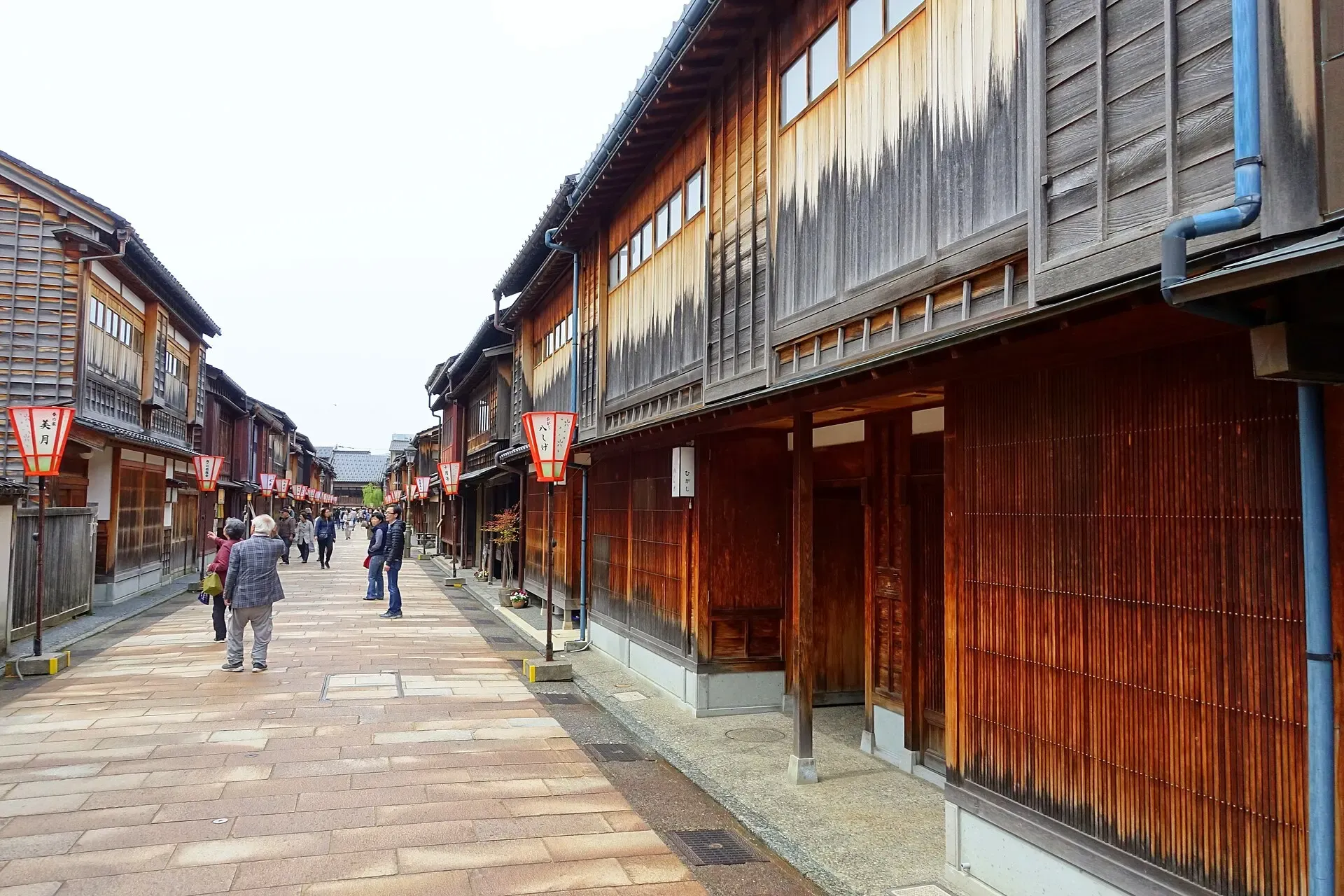
That is worth ten minutes before you go back out and photograph the street, which is what most people do instead, because from outside all you can see is the lattice.
Before you pick a door
Three buildings here publish an admission fee, an opening time and a closing day. All three went up in 1820 — Bunsei 3 — the year the district itself was laid out east of the Asano River with the Kaga domain’s permission.
That is where the agreement ends.
- 9:30 — Shima (¥500) and the Ochaya Museum (¥500) open
- 10:00 — Kaikaro (¥750) opens, and so does most of the street
- Thursday — the Ochaya Museum is shut
- Any day — Shima is listed as open 365 days a year; Kaikaro names no closing day at all
If you only remember one line of this, remember the Thursday.
Figure 1
The half hour the street gives you
Between 9:30 and 10:00 you can be inside a building while the street outside is still shuttered. That is the whole gift of arriving early here, and it is thirty minutes long.
Shima holds the highest designation of the three — a National Important Cultural Property — and it is also the cheapest, which means the building with the strongest protection is the one asking you for the least. Go up the stairs first and look at the street later.
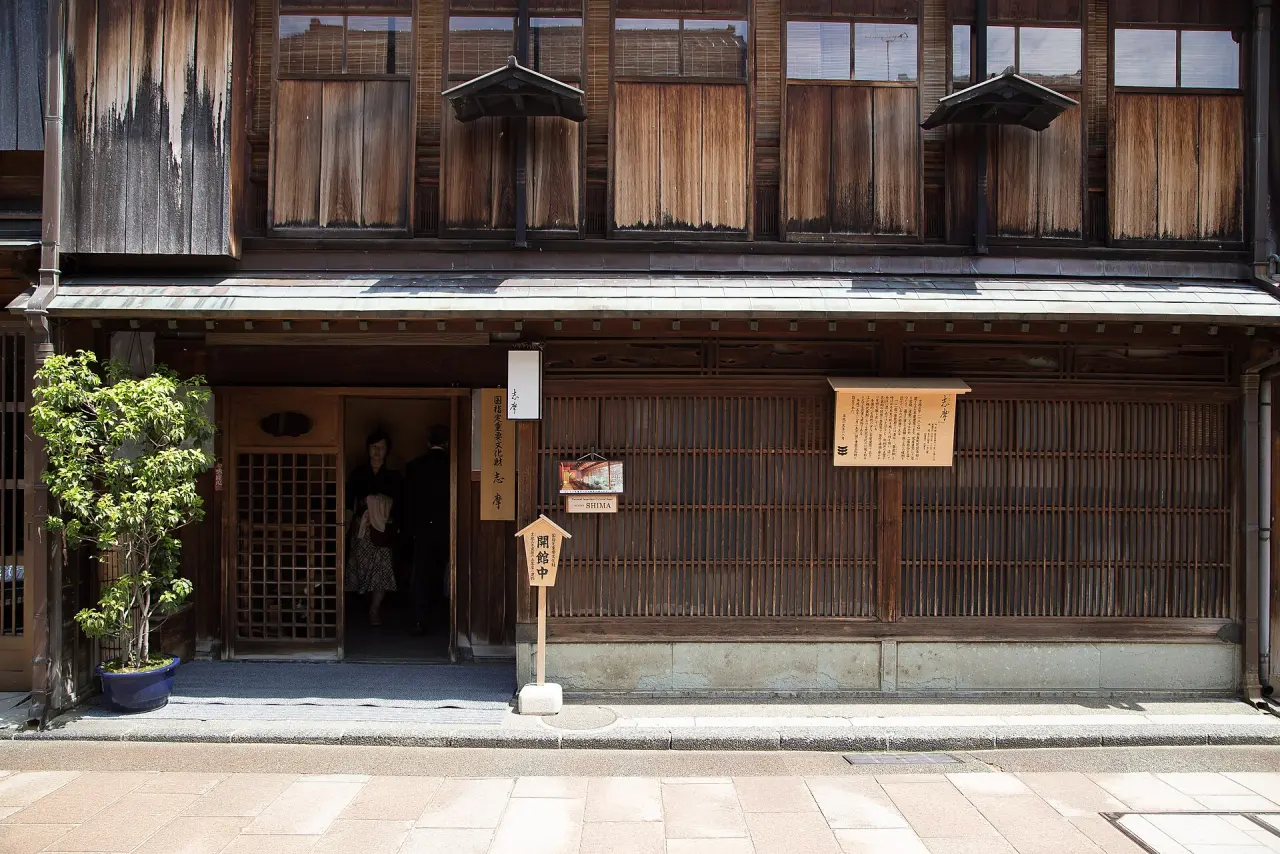
There is a second building in the grounds, Kansetsuan, where matcha is served for an extra charge. If you want to sit down rather than keep moving, sit here — it is the one place on this street built for staying still. The bowl is hot at the base and the first mouthful is sharper than you expect if you have only had matcha in a latte.
Hours are 9:30 to 17:30, dropping to 17:00 from December through February, so in winter you lose the last half hour and should work backwards from five rather than half past.
If it is a Thursday, you have two doors, not three
The Ochaya Museum opens at the same time, also for 500 yen, also built in 1820, and closes at 17:00 with last entry at 16:30 — so your real deadline is half past four.
Its ground floor holds the things the banquets were actually furnished with: Kaga inlay, Kaga lacquer, Kutani ware. Shima shows you the empty room. This shows you what used to be carried into it, which is the half of the picture the empty room cannot give you.
And it closes on Thursdays. If that is your morning, do not spend it wondering — go to Shima at 9:30 and give the second slot to Kaikaro at ten.
10:00 — the biggest one, and the one you cannot plan around
Kaikaro opens at 10:00, which means it is never the first door of your day. It costs 750 yen, the city describes it as Kanazawa’s largest teahouse building, and inside there is a tatami room with walls the colour of deep ultramarine — not a colour anyone associates with a wooden street from 1820, and the reason most photographs of this building are of that one room.
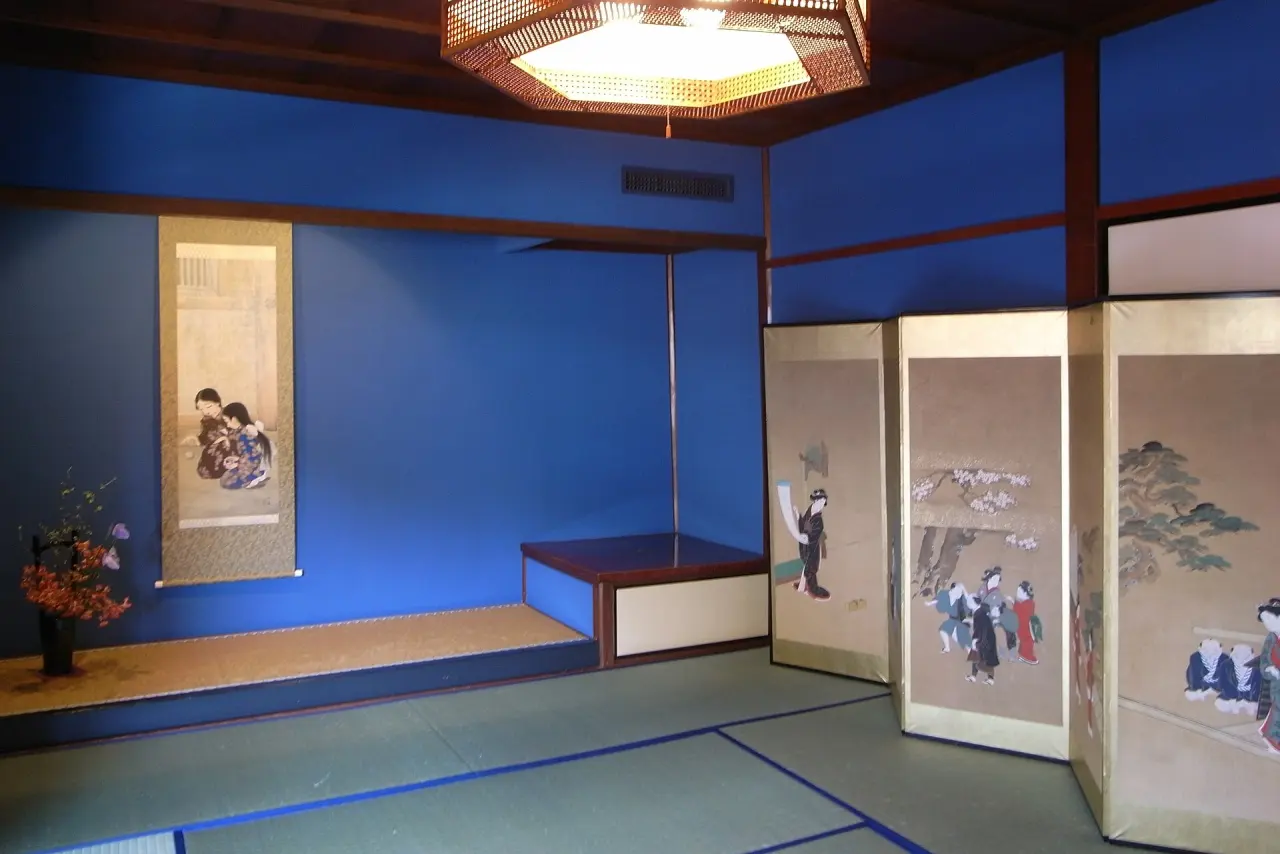
But its entry names no fixed closing day and says the hours move when there is a banquet, which means the largest building on the street is the one you cannot build a morning around. Take it when you are already here and it is open. Do not make it the reason you came.
Most of the street’s shops run 10:00 to 17:00, so ten is when the street itself wakes up rather than when one building does.
15:00 — the only published door, and what it costs
The official guide to this district is blunt about the teahouses still working as teahouses: ichigen-san okotowari is still observed, and without an introduction from someone the house already knows, you do not get in. Five teahouses are described as still operating that way.
But the same organisation publishes one way in, with a price on it.
At the teahouse Fujinoya, a zashiki session runs 15:00 to 16:00, one hour, for 16,500 yen per person — which means one hour here costs thirty-three times the 500 yen that gets you into Shima for the whole day. It takes a minimum of two people and a maximum of eight, so you cannot do this alone. You telephone to book by three days before the date you want, and the booking is completed by bank transfer by that same deadline. Drinks and an otōshi are included. Cancellation is 30% at two days out, 50% the day before, and 100% on the day.
Read the deadline before you read the price. This is not a door you can open on the afternoon you happen to be standing in front of it — it closes three days before you arrive. If you want it, book it from home while you are still planning the trip. If you decide on the street, you have already missed it.
17:00 — the buildings go back to being what they are
Most shops are listed to 17:00. Shima runs to 17:30 outside winter. Kaikaro’s own site draws the line plainly: by day it is open to the public, and at night it keeps ichigen-san okotowari, one party at a time.
So the building you paid 750 yen to walk through in the morning becomes, in the evening, the thing it was built as. The public hours are the exception here, not the condition. You have not been visiting a museum that happens to look like a teahouse. You have been let in, for a few hours, to a building that spends the rest of its day saying no.
Stay until the shutters start going up. It is the only time of day the street tells you what it is.
Two things worth knowing before you buy anything
The gold leaf is real. Its link to this street is not. Buy it because you want it, not as a souvenir of this place’s history. The record gives three dates and they do not join up: in 1696 a leaf guild office was established in Edo and the manufacture and sale of gold and silver leaf was prohibited nationally; in 1820 this teahouse district was created with the Kaga domain’s permission; in 1845 the Kaga domain obtained official permission from the shogunate regarding leaf. Two permissions, a hundred and twenty-five years apart, granted by different authorities to different trades — and the city’s own feature on gold leaf explains the craft at length without mentioning this district at all.
The street’s protection is not the same as the building’s. About a third of what you walk past is not counted as a traditional building, and Shima’s National Important Cultural Property status belongs to Shima alone. So if you want to stand inside something carrying that protection, buy the ticket. Walking the street does not get you there.
The practical page
| Shima | Kaikaro | Ochaya Museum | |
|---|---|---|---|
| Designation | National Important Cultural Property | Kanazawa-designated preserved building | Kanazawa-designated cultural property |
| Built | Bunsei 3 (1820) | 1820 | Bunsei 3 (1820) |
| Adult | ¥500 | ¥750 | ¥500 |
| Child | ¥300 | ¥500 (elementary–high school) | ¥300 (elementary/junior high) |
| Opens | 9:30 | 10:00 | 9:30 |
| Closes | 17:30 (17:00 Dec–Feb) | 17:00 (varies with banquets) | 17:00 (last entry 16:30) |
| Closed | Open 365 days a year | Futeikyū — no fixed closing day | Thursdays |
| Address | 1-13-21 Higashiyama | 1-14-8 Higashiyama | 1-13-7 Higashiyama |
| Phone | 076-252-5675 | 076-253-0591 | 076-252-0887 |
Zashiki session at Fujinoya: ¥16,500 per person, 2–8 people, 15:00–16:00, booked by telephone and paid by bank transfer three days ahead.
District: Higashiyama-Higashi, selected nationally on 14 November 2001. About 1.8 hectares, 140 buildings, roughly two-thirds counted as traditional. Kanazawa lists four nationally selected districts — Higashiyama-Higashi (2001), Kazuemachi (2008), Utatsusan-Roku (2011) and Teramachidai (2012). Nishi Chaya, the third teahouse street, is not among them.
One note on the child rate at Shima, if you are travelling with a teenager. The Japanese official page gives the 300 yen rate to chūgakusei ika — junior high school age and below, which in Japan ends at fifteen. The English version of the same official page gives it to “person of 16 years old and below.” At sixteen, the two official pages of the same organisation say different things, so ask at the desk rather than budgeting on either. Checked 21 September 2026.
Fitting it into a Kanazawa day
If you want to eat before you come, Omicho Market has counters serving from seven, which is well before anything on this street opens. For the hours after five, Kanazawa Castle Park and Kenrokuen both stay open later than the teahouses, and both have free hours the teahouses do not.
What I would do
I would be at Shima when it opens and I would go straight up, before the street fills and before I had taken a single photograph of a lattice.
I would sit at Kansetsuan long enough to finish the matcha properly. Then I would come out into whatever had just opened, and I would stay until the shutters started going up, because the moment the street closes to you is the moment you understand what you were let into.
Sources and images
- Ishikawa Prefecture — the district’s creation in Bunsei 3 (1820) with the permission of the Kaga domain, the area of about 1.8 hectares, the count of 140 buildings of which roughly two-thirds are traditional buildings, and the description of the two-storey frontages. Checked 14 September 2026.
- Kanazawa City — the four districts the city lists as nationally selected, with their selection dates: Higashiyama-Higashi (14 November 2001), Kazuemachi (2008), Utatsusan-Roku (2011) and Teramachidai (2012). Checked 14 September 2026.
- Kanazawa City Tourism Association — admission, opening hours and closing days for Shima, Kaikaro and the Ochaya Museum; Shima’s second floor as the guest floor and the building’s construction around the performing arts; Kansetsuan in the grounds and the additional charge for matcha; the Ochaya Museum’s ground-floor holdings of Kaga inlay, Kaga lacquer and Kutani ware; the statement that five teahouses are still operating and that ichigen-san okotowari is still observed; the shops’ 10:00 to 17:00; and the Fujinoya zashiki session with its price, party size, three-day booking deadline and cancellation terms. Japanese and English pages read against each other. Checked 14 September 2026.
- VISIT KANAZAWA (the association’s English site) — the English wording of Shima’s hours, its 365-day opening, and the child admission band, which differs from the Japanese page. Checked 21 September 2026.
- Kaikaro (the teahouse’s own site) — the 1820 construction date, and the statement that the building is open to the public by day and keeps ichigen-san okotowari at night, one party at a time. Checked 14 September 2026.
- Yasue Gold Leaf Museum, Kanazawa City — the 1696 establishment of the hakuza in Edo and the prohibition on manufacturing and selling gold and silver leaf, and the official permission obtained by the Kaga domain in Kōka 2 (1845). Checked 14 September 2026.
- Photographs: the street by Daderot (CC0, Wikimedia Commons); Shima by epicureanism (CC BY 2.0, Wikimedia Commons); the room inside Kaikaro by na0905 (CC BY 2.0, Wikimedia Commons).
- Diagram drawn by us from the hours published by the sources above.