Naha / Stay
Where to Stay in Naha: The Train to Itoman Is Gone, but You Can Keep Your Room
Where to Stay那覇の宿
The monorail that brings you in from the airport never goes near Itoman, in the south. A train once did, and the turntable that swung its engines around at Naha Station now sits in the open square beside the bus terminal at Asahibashi. Today a bus does the run, and you may not need to change hotels to catch it. The 89 leaves the terminal, calls at a stop named for the Prefectural Office’s south entrance and at Kainan, and only then comes back by the terminal and heads south. So if you are staying near Kokusai Street, check where those stops are from your hotel before you pack up for a last night by the terminal.
The choice that does change your stay is whether to sleep up the hill at Shuri. Up there, the hotel’s top-floor lounge turns from sunset to city lights, and the old stone path is just below the castle. In exchange, the road up from the station is steep enough that the hotel tells you to take a taxi.
The turntable by the bus terminal
Naha’s railway was a light railway, and the city’s history museum says it was affectionately known as the Kēbin. Its trains took about fifty minutes to reach Itoman. Naha Station was badly hit in an air raid in the last autumn of the war; the trains ran again a month later, and stopped the following spring, when American attacks destroyed the station.
After the war there was a plan to bring the railway back, but the main roads came first, and later what was left of the rails and carriages went for scrap. That is why the turntable matters to me: it belonged to a railway that went where you now want to go, and you can still walk up to it.
The station stood where the new buildings by the terminal are now. The turntable’s remains were moved into the square between them and Asahibashi Station, where they are on show. The bus to Itoman leaves from the terminal beside it.
Stay near Kokusai Street, even for an early bus south
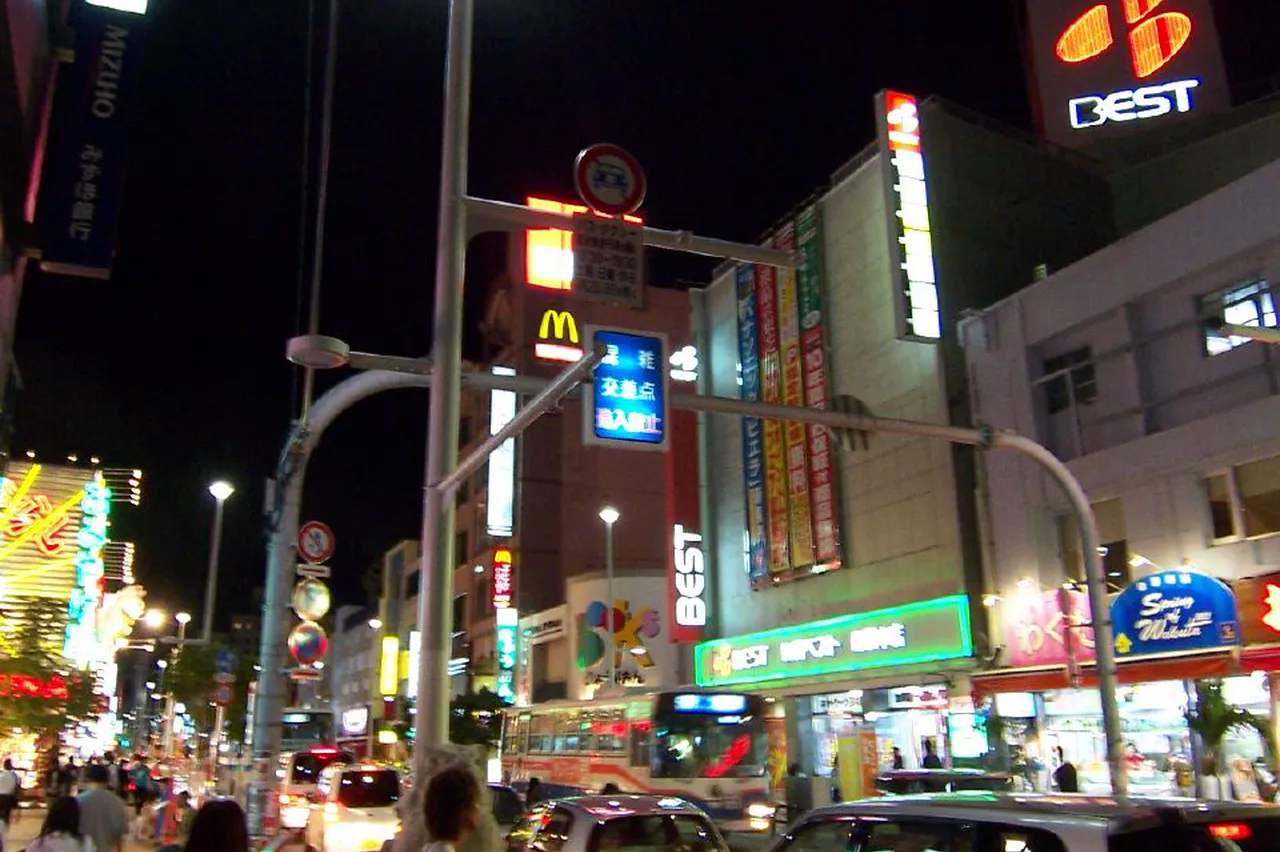
Kokusai Street runs for about a mile, from the Prefectural Office to the Asato crossing past Makishi, and it stays busy late into the night. From its middle you can walk into the arcades, to the market where some of the fish you buy downstairs can be cooked upstairs, and on to the potters’ street at Tsuboya. If you are here on a Sunday afternoon, you will usually find most of it closed to cars, and, the tourist association says, Eisa dancing or street music may fill the middle of it.
For an early morning at Itoman’s market, you may not need to move. Prefectural Office Station, at Kokusai Street’s southern end, stands beside the office itself, and the 89 calls at Kencho Minamiguchi, the stop named for its south entrance, and then at Kainan, a few minutes after leaving the terminal. Check the morning departures with Okinawa Bus, and avoid a Sunday: that day the market’s butchers are all shut.
One hotel we would look at: OMO5 Okinawa Naha. You can walk to Kokusai Street from here, and its lounge is designed around hana-burokku, Okinawa’s traditional patterned blocks. Its yachimun rooms, named for Okinawan pottery, are limited to four a day; if Tsuboya is on your list, ask for one. If the Kerama islands are part of your trip, the hotel also puts you near Tomari Port, where the ferries leave. You can come back in the evening to sanshin music or a night market, every night.
Or: The Royal Park Hotel Iconic Naha, which opened this year on the upper floors of the Bank of the Ryukyus’ new head office, a short walk from Prefectural Office Station. Its lobby uses Ryukyu limestone and a large screen of bashōfu, Okinawa’s banana-fibre cloth, and out on the terrace stands a banyan brought down from Nakijin in the north. Ask for the 11th floor or above: from there, its general manager says, you can see the sea and Shuri Castle.
Or stay by the terminal, at Asahibashi
Sleep here and the turntable is a few steps away, in the square by the station. The 89 to Itoman leaves from the terminal and calls there again on its way south, so you can catch it at either end of its loop. Asahibashi is also the stop on this page nearest the airport by monorail.
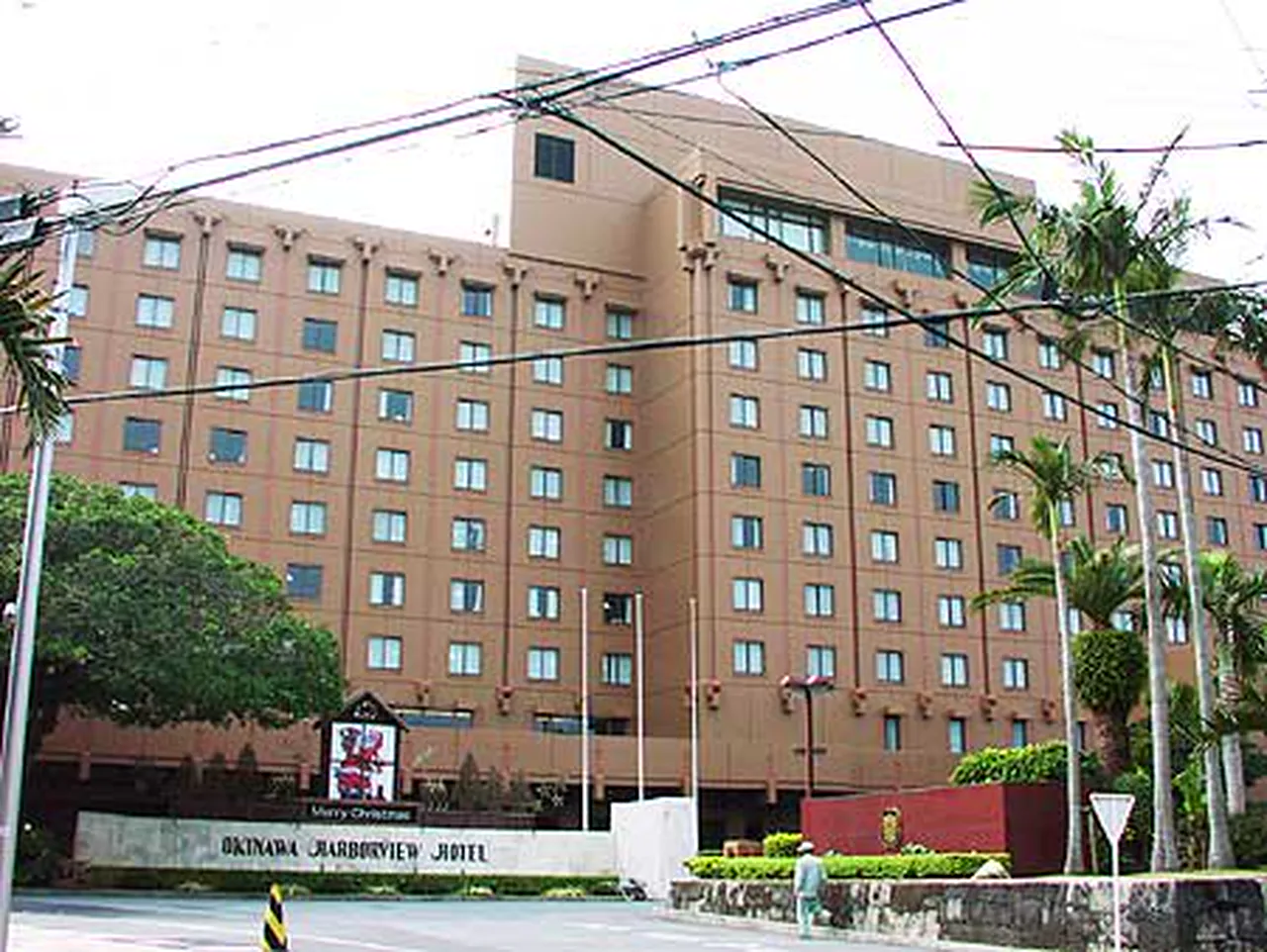
One hotel we would look at: Okinawa Harborview Hotel. You are a few minutes’ walk from the terminal here, at a hotel opened in 1975, with walls in an ochre red meant to recall Okinawa’s soil and shisa, Okinawa’s protective figures that ward off evil, fixed to the building. Inside, you will find a whole wall carved with them. After dark its garden pool is lit in colour, and on Friday and Saturday evenings there is live music by the pool around sunset, saxophone among it.
If you want Shuri at dusk, sleep on the hill
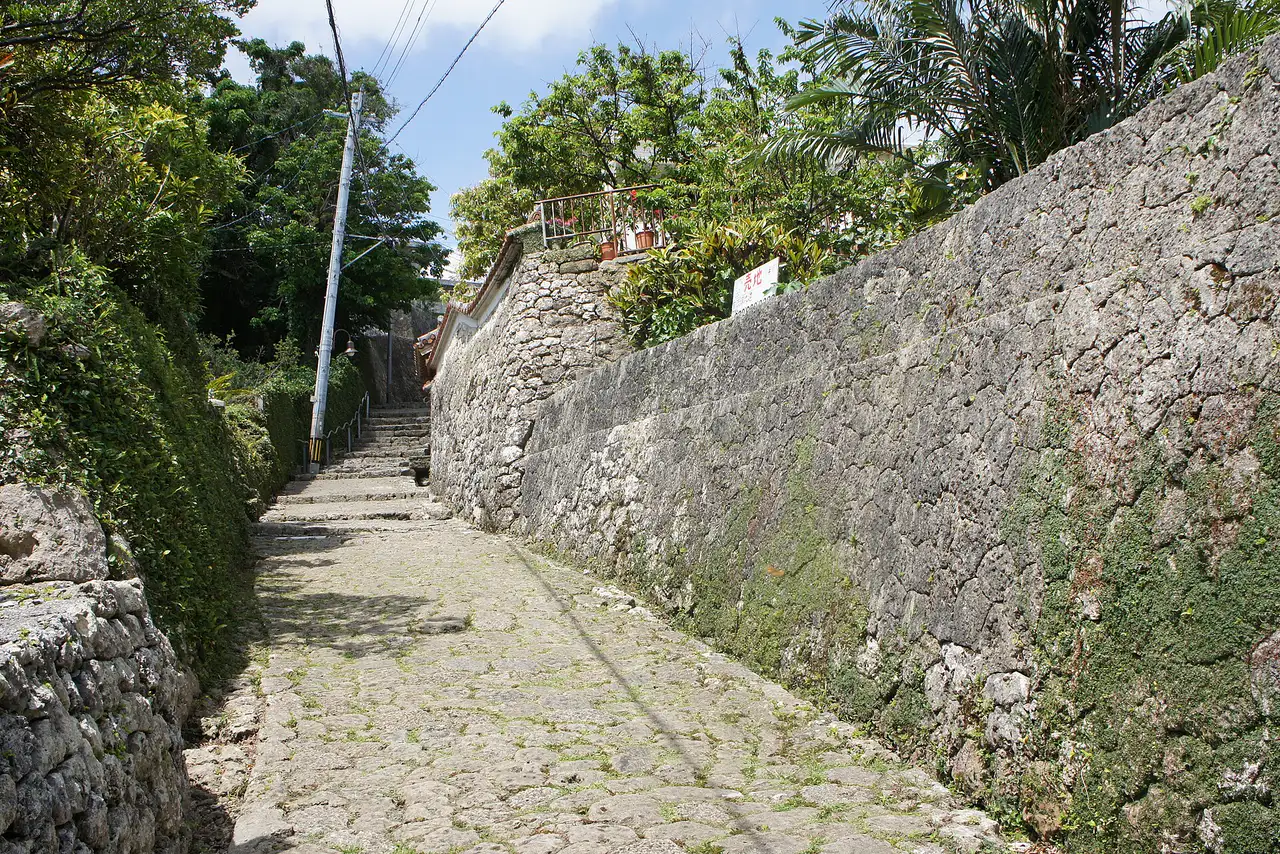
Below the castle, about 300 metres of the old stone road to the port came through the war, with red-tiled houses along it. Sleep up here and you can walk the castle and the path late in the day, and end it at the hotel rather than on the monorail. If you come in summer, there is one more reason, the city’s tourist association says: along Zuisen Street, trees of sagaribana open their flowers at night and drop them by morning, and the street smells sweet in the evening.
One hotel we would look at: DoubleTree by Hilton Naha Shuri Castle. It calls itself the hotel closest to Shuri Castle; you can walk to the Shureimon gate from here. Its top-floor lounge looks out over the whole city, and I would be up there before sunset, and stay while the lights come on across the city below. This is the trade: the road up from Shuri Station is steep, the hotel itself recommends a taxi, and its shuttle to Kokusai Street has ended. For a bus to Itoman, you would start the morning by coming down the hill.
Before you go
| Yui Rail (monorail) from Naha Airport | Asahibashi 11 minutes, Prefectural Office (Kencho-mae) 13, Makishi 16, Shuri 27 |
| Between areas | Asahibashi ↔ Prefectural Office 2 minutes, Makishi ↔ Shuri 11 minutes by monorail |
| Kokusai Street | About 1.6 km, from the Prefectural Office to the Asato crossing. On Sundays 12:00–18:00, about 1.3 km is normally closed to cars; cancelled in rain |
| To Itoman: route 89 | Itoman line, timetable in force from 19 October 2026. Leaves Naha Bus Terminal (stand 3), stops at Kencho Minamiguchi and Kainan (the timetable lists no time for Kencho Minamiguchi), passes Asahibashi / Naha Bus Terminal again, then runs south to Itoman Shijo Iriguchi (market) and Itoman Bus Terminal. First bus on weekdays: terminal 6:22, Kainan 6:26, Asahibashi 6:36, Itoman Bus Terminal 7:12. Weekends and holidays: 6:45, 6:49, 6:59, 7:35 |
| To Itoman: other routes | Okinawa Bus routes 34 and 35 from Naha Bus Terminal (stand 6); 334 and 235 from the stop in front of it. Their timetables on Okinawa Bus’s site are dated October 2024; check current departures |
| The turntable | Moved and on display in the square between Asahibashi Station and the buildings beside it. Naha Station’s railway: from 1914 to the Battle of Okinawa; Itoman line from 1923 |
| To the islands | Ferries to Tokashiki, Zamami, Aka and other islands from Tomari Port (Tomarin), about 10 minutes on foot from Miebashi Station. Terminal building open 7:00–19:00 |
| OMO5 Okinawa Naha | About 6 minutes on foot from Prefectural Office Station, 8 from Miebashi. Four yachimun rooms a day |
| The Royal Park Hotel Iconic Naha | Opened 30 January 2026, above the Bank of the Ryukyus head office. About 2 minutes on foot from Prefectural Office Station |
| Okinawa Harborview Hotel | Opened 1975. About 5 minutes on foot from Naha Bus Terminal, about 10 from Asahibashi or Tsubogawa Station. Garden pool reopened after renovation in June 2026 |
| DoubleTree by Hilton Naha Shuri Castle | About 13 minutes on foot to Shureimon. From Shuri Station about 5 minutes by taxi (the road up is steep; the hotel recommends a taxi). Its shuttle bus to Kokusai Street has ended. Outdoor pool open in season (the 2026 season ended on 31 October) |
| Sagaribana on Zuisen Street | June to August, flowers open at night |
Bus times checked 11 November 2026; everything else 7 October 2026. We list no room rates.
Where I would sleep
I would stay near Kokusai Street the whole time, in a yachimun room, and on the last morning take the 89 from Kencho Minamiguchi instead of moving my bags. It would call at the terminal by the turntable, then carry me on to Itoman’s market, the town the train used to reach.
For every area on this page, see hotels in Naha on Expedia. That is an affiliate link: if you book through it, we earn a commission.
We have not stayed at any of the places on this page or visited the areas described. The facts here come from the official sources below, checked on 7 October 2026; the bus times were checked on 11 November 2026.
- Naha City Museum of History — Naha Station, the light railway, the Itoman line and what became of it: rekishi-archive.city.naha.okinawa.jp
- Yui Rail (Okinawa Urban Monorail) — travel times, the stations, Kokusai Street and the turntable: yui-rail.co.jp
- Naha City Tourist Association — Kokusai Street on Sundays, the Kinjo-cho stone path, Zuisen Street, Tomari Port: naha-navi.or.jp
- Kokusai Street shopping association — the Sunday pedestrian street: naha-kokusaidori.okinawa
- Okinawa Bus — routes from Naha Bus Terminal to Itoman, the route 89 timetable (from 19 October 2026) and its stop order: okinawabus.com
- Tomarin — island ferries and the terminal: tomarin.co.jp
- OMO5 Okinawa Naha (Hoshino Resorts) — rooms, the lounge, evenings and access: hoshinoresorts.com
- The Royal Park Hotel Iconic Naha — opening, the building, the lobby and access: royalparkhotels.co.jp
- Okinawa Harborview Hotel — history, the building, the pool and access: oka-hvh.com
- DoubleTree by Hilton Naha Shuri Castle — location, the lounge, the pool and access: doubletree-shuri.hiltonjapan.co.jp
- Photographs: Kokusai Street at night by Hajime NAKANO (CC BY 2.0); Okinawa Harborview Hotel by N (public domain); the Kinjo-cho stone path by 663highland (CC BY 2.5). All from Wikimedia Commons. The hero image is an AI-generated photo illustration, not a photograph of any place to stay on this page.
More in Naha
- Kokusai Street and Makishi Market — For choosing a fish downstairs and having a diner cook it upstairs
- Shuri Castle and the Kinjo-cho Stone Path — For the castle, a royal tomb, and a stone path that came through the Battle of Okinawa
- Tsuboya Yachimun Street — For a potter’s house and its red-tiled kiln, on a Friday, weekend or holiday afternoon
- Itoman Market Itomaru — For an early morning at a town market, where island vegetables are sold at a price you agree out loud
Explore other areas
- Hokkaido — Sapporo
- Kanto — Hakone, Tokyo
- Hokuriku — Kanazawa
- Koshin-Tokai — Fuji Five Lakes
- Kansai — Nara
- Chugoku — Hiroshima
- Kyushu — Fukuoka
- Okinawa — Naha · You are here
